login
Hints
(Greetings from The On-Line Encyclopedia of Bongard Problems!)
Search:  https://www.galaxus.ch/en/sector/showdiscussion/snapchathacking-visit-kunghaccom-5hflaboo-226168
Displaying 461-470 of 681 results found. ( prev | next )     page 1 ... 43 44 45 46 47 48 49 50 51 ... 69
     Sort: relevance      Format: long      Filter: (all | no meta | meta)      Mode: (words | no words)
BP367 Center of mass within the black area of the shape vs. center of mass out of the black area of the shape.
(edit; present; nest [left/right]; search; history)
CROSSREFS

Adjacent-numbered pages:
BP362 BP363 BP364 BP365 BP366  *  BP368 BP369 BP370 BP371 BP372

KEYWORD

precise, unstable, physics, perfect, pixelperfect, traditional

CONCEPT inside (info | search),
center_of_mass (info | search)

WORLD

shape [smaller | same | bigger]
zoom in left (shape_center_of_mass_falls_inside)

AUTHOR

Aaron David Fairbanks

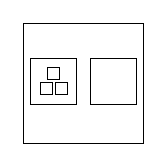
BP1257 The rule is about squares having a certain relationship with their neighbors vs. it is not.
(edit; present; nest [left/right]; search; history)
COMMENTS

"Local vs. global."


For clarity, rules involving diagonal neighbors or squares more than one step away are never used.


The similar solution "Each square can be deduced from its neighbors vs. not so" does not quite work; for example EX8114 would then not fit left. See also BP1258 ("Each square can be deduced from the rest vs. not so").

CROSSREFS

Adjacent-numbered pages:
BP1252 BP1253 BP1254 BP1255 BP1256  *  BP1258 BP1259 BP1260 BP1261 BP1262

KEYWORD

structure, rules, grid, miniworlds

CONCEPT local_global (info | search)

WORLD

grid_of_images_with_rule [smaller | same | bigger]

AUTHOR

Aaron David Fairbanks

BP191 Orifice on the left vs. orifice on the right.
(edit; present; nest [left/right]; search; history)
CROSSREFS

Adjacent-numbered pages:
BP186 BP187 BP188 BP189 BP190  *  BP192 BP193 BP194 BP195 BP196

KEYWORD

nice, traditional

CONCEPT entrance_exit (info | search),
left_right (info | search)

WORLD

[smaller | same | bigger]

AUTHOR

Harry E. Foundalis

BP1130 Start with a rectangle subdivided further into rectangles and shrink the vertical lines into points vs. the shape does not result from this process.
?
(edit; present; nest [left/right]; search; history)
COMMENTS

The description in terms of rectangles was noted by Sridhar Ramesh when he solved this.


All examples in this Bongard Problem feature arced line segments connected at endpoints; these segments do not cross across one another and they are nowhere vertical; they never double back over themselves in the horizontal direction.

Furthermore, in each example, there is a single leftmost point and a single rightmost point, and every segment is part of a path bridging between them. So, there is a topmost total path of segments and bottommost total chain of segments.


Any picture on the left can be turned into a subdivided rectangle by the process of expanding points into vertical lines.


Here is another answer:

"Right examples: some junction point has a single line coming out from either the left or right side."


If there is some junction point with only a single line coming out from a particular side, the point cannot be expanded into a vertical segment with two horizontal segments bookending its top and bottom (as it would be if this were a subdivision of a rectangle).


And this was the original, more convoluted idea of the author:

"Start with a string along the top path. Sweep it down, region-by-region, until it lies along the bottom path. The string may only enter a region when it fully covers that region's top edge and likewise it must exit by fully covering the bottom edge. Only in left images can this process be done so that no segment of the string ever hesitates."

Quite convoluted when spelled out in detail, but not terribly complicated to imagine visually. (See the keyword unwordable.)


The string-sweeping answer is the same as the rectangle answer because a rectangle represents the animation of a string throughout an interval of time. (A horizontal cross-section of the rectangle represents the string, and the vertical position is time.) Distorting the rectangle into a new shape is the same as animating a string sweeping across that new shape.

In particular, shrinking vertical lines of a rectangle into points means just those points of the string stay still as the string sweeps down.

The principle that horizontal lines subdividing the original rectangle become the segments in the final picture corresponds to the idea that the string must enter or exit a single region all at once.

CROSSREFS

BP1129 started as an incorrect solution for this Bongard Problem. Anything fitting right in BP1130 fits right in BP1129.

Adjacent-numbered pages:
BP1125 BP1126 BP1127 BP1128 BP1129  *  BP1131 BP1132 BP1133 BP1134 BP1135

KEYWORD

hard, unwordable, solved

CONCEPT topological_transformation (info | search),
imagined_motion (info | search)

WORLD

[smaller | same | bigger]

AUTHOR

Aaron David Fairbanks

BP933 Ball will reach edge of bounding box under gravity vs. not so.
(edit; present; nest [left/right]; search; history)
COMMENTS

Strictly this Problem's solution is not actually about gravity, it is about a constant downwards force (the ball's time-independent path does not depend on the magnitude of the force, only direction). The phrasing for the solution is a shorthand that takes advantage of human physical intuition.

CROSSREFS

Adjacent-numbered pages:
BP928 BP929 BP930 BP931 BP932  *  BP934 BP935 BP936 BP937 BP938

KEYWORD

physics

CONCEPT bounding_box (info | search),
imagined_motion (info | search),
gravity (info | search)

WORLD

dot_with_lines_or_curves [smaller | same | bigger]

AUTHOR

Leo Crabbe

BP309 Ball touches curve at a point of local minimum downwards vs. ball touches curve at a point of local maximum upwards.
(edit; present; nest [left/right]; search; history)
CROSSREFS

Adjacent-numbered pages:
BP304 BP305 BP306 BP307 BP308  *  BP310 BP311 BP312 BP313 BP314

KEYWORD

traditional

CONCEPT local_max_min (info | search),
separation_of_joined_objects (info | search)

AUTHOR

"Lewis"

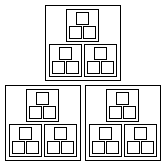
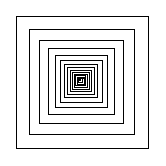
BP1059 No infinite nesting vs. some infinite nesting.
(edit; present; nest [left/right]; search; history)
CROSSREFS

Adjacent-numbered pages:
BP1054 BP1055 BP1056 BP1057 BP1058  *  BP1060 BP1061 BP1062 BP1063 BP1064

KEYWORD

perfect, infinitedetail

CONCEPT finite_infinite (info | search),
fractal (info | search),
recursion (info | search),
self-reference (info | search)

WORLD

recursive_boxes [smaller | same | bigger]

AUTHOR

Aaron David Fairbanks

BP255 Three pairs of parallel and non-collinear pieces of straight lines, each pair with a different slope vs. not so.
(edit; present; nest [left/right]; search; history)
CROSSREFS

Adjacent-numbered pages:
BP250 BP251 BP252 BP253 BP254  *  BP256 BP257 BP258 BP259 BP260

KEYWORD

traditional

CONCEPT feature_cluster (info | search),
cluster (info | search),
three (info | search),
parallel (info | search)

AUTHOR

Andreas Gunnarsson

BP64 A cross is located on the extension of the ellipse axis vs. a circle is located on the extension of the ellipse axis.
(edit; present; nest [left/right]; search; history)
REFERENCE

M. M. Bongard, Pattern Recognition, Spartan Books, 1970, p. 235.

CROSSREFS

Adjacent-numbered pages:
BP59 BP60 BP61 BP62 BP63  *  BP65 BP66 BP67 BP68 BP69

KEYWORD

noisy, dual, finished, orderedtriplet, traditional, bongard

CONCEPT collinear (info | search),
imagined_line_or_curve (info | search),
imagined_entity (info | search)

WORLD

[smaller | same | bigger]

AUTHOR

Mikhail M. Bongard

BP88 Three parts vs. five parts.
(edit; present; nest [left/right]; search; history)
REFERENCE

M. M. Bongard, Pattern Recognition, Spartan Books, 1970, p. 243.

CROSSREFS

Adjacent-numbered pages:
BP83 BP84 BP85 BP86 BP87  *  BP89 BP90 BP91 BP92 BP93

KEYWORD

number, finished, traditional, bongard

CONCEPT number (info | search),
separation_of_joined_objects (info | search),
three (info | search),
five (info | search)

AUTHOR

Mikhail M. Bongard

( prev | next )     page 1 ... 43 44 45 46 47 48 49 50 51 ... 69

Welcome | Solve | Browse | Lookup | Recent | Links | Register | Contact
Contribute | Keywords | Concepts | Worlds | Ambiguities | Transformations | Invalid Problems | Style Guide | Goals | Glossary