Search: -meta:BP550
|
| |
|
| BP842 |
| Any permutation of positions that sends one string of symbols to another sends each string of symbols to some other versus not so. |
|
| |
|
| |
| |
|
|
| |
|
| BP851 |
| Figure with points (small white circles) can be smoothly deformed within the 2D plane without passing through itself so that all points touch to make the other figure vs. not so (movement out of the plane required). |
|
| |
|
| |
| |
|
|
| |
|
| BP897 |
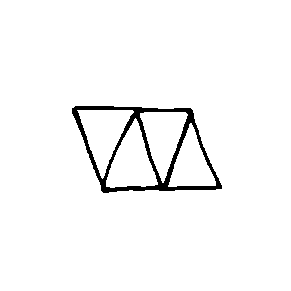
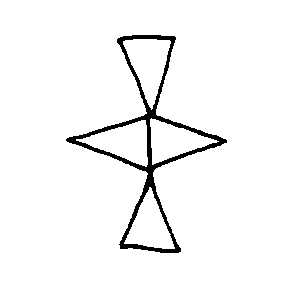
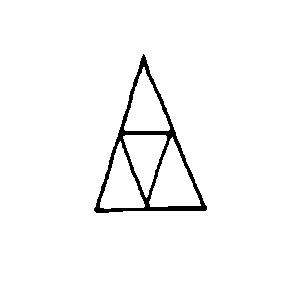
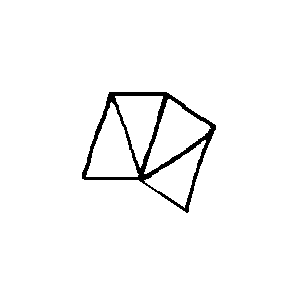
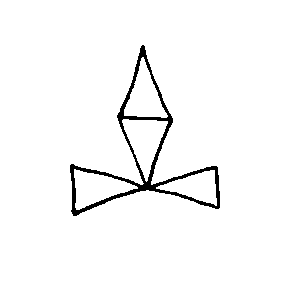
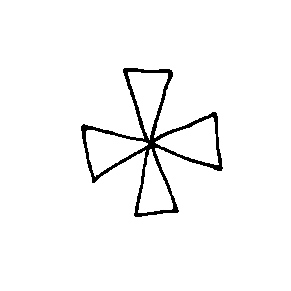
| Wide angles connected to narrow angles vs. not so. |
|
| |
|
| |
| |
|
|
| |
|
| BP924 |
| Polygons where all sides are different lengths vs. Polygons where not all sides are different lengths. |
|
| |
|
|
|
|
COMMENTS
|
All examples in this Problem are outlines of convex polygons.
This is a generalisation of scalene triangles to any polygon. |
|
|
CROSSREFS
|
The left side implies the right side of BP329 (regular vs. irregular polygons), but the converse is not true.
The left side of BP329 implies the right side, but the converse is not true.
Adjacent-numbered pages:
BP919 BP920 BP921 BP922 BP923 * BP925 BP926 BP927 BP928 BP929
|
|
|
EXAMPLE
|
Any scalene triangle will fit on the left, because no two sides are equal.
However, any regular polygon will not fit on the left, because all of its sides are equal.
A random convex polygon will "almost surely" fit on the left. |
|
|
KEYWORD
|
nice, stretch, right-narrow, traditional
|
|
|
CONCEPT
|
all (info | search)
|
|
|
WORLD
|
polygon_outline [smaller | same | bigger]
|
|
|
AUTHOR
|
Jago Collins
|
| |
|
|
| |
|
| BP925 |
| The numbers of dots differ by three vs. not so. |
|
| |
|
| |
| |
|
|
| |
|
| BP926 |
| Numbers of dots in ascending order from left to right vs. numbers of dots neither in ascending nor descending order from left to right. |
|
| |
|
| |
| |
|
|
| |
|
| BP928 |
| All subsets of a collection vs. not. |
|
| |
|
| |
| |
|
|
| |
|
| BP931 |
| Some number labels its own position in the sequence from left to right vs. not so. |
|
| |
|
| |
| |
|
|
| |
|
| BP949 |
| Two unique distances between points vs. three unique distances between points. |
|
| |
|
| |
| |
|
|
| |
|
| BP956 |
| Nested pairs of brackets vs. other arrangement of brackets (some open brackets are not closed or there are extra closing brackets). |
|
| |
|
|
|
|
COMMENTS
|
Examples on the left are also known as "Dyck words". |
|
|
REFERENCE
|
https://en.wikipedia.org/wiki/Dyck_language |
|
|
CROSSREFS
|
Adjacent-numbered pages:
BP951 BP952 BP953 BP954 BP955 * BP957 BP958 BP959 BP960 BP961
|
|
|
KEYWORD
|
easy, nice, precise, allsorted, unwordable, notso, sequence, traditional, inductivedefinition, preciseworld, left-listable, right-listable
|
|
|
CONCEPT
|
recursion (info | search)
|
|
|
AUTHOR
|
Aaron David Fairbanks
|
| |
|
|
Welcome |
Solve |
Browse |
Lookup |
Recent |
Links |
Register |
Contact
Contribute |
Keywords |
Concepts |
Worlds |
Ambiguities |
Transformations |
Invalid Problems |
Style Guide |
Goals |
Glossary
|
|
|
|
|
|
|
|
|
|