Search: https://www.galaxus.ch/en/sector/showdiscussion/snapchathacking-visit-kunghaccom-5hflaboo-226168
|
| |
|
| BP48 |
| Solid dark figures above the outline figures vs. outline figures above the solid dark figures. |
|
| |
|
|
|
|
REFERENCE
|
M. M. Bongard, Pattern Recognition, Spartan Books, 1970, p. 229. |
|
|
CROSSREFS
|
Adjacent-numbered pages:
BP43 BP44 BP45 BP46 BP47 * BP49 BP50 BP51 BP52 BP53
|
|
|
KEYWORD
|
noisy, finished, traditional, viceversa, bongard
|
|
|
CONCEPT
|
above_below (info | search),
average (info | search),
outlined_filled (info | search),
feature_cluster (info | search),
cluster (info | search),
texture (info | search)
|
|
|
WORLD
|
circle_square_eq-tri_small_some_outline_some_fill [smaller | same | bigger]
|
|
|
AUTHOR
|
Mikhail M. Bongard
|
| |
|
|
| |
|
| BP1239 |
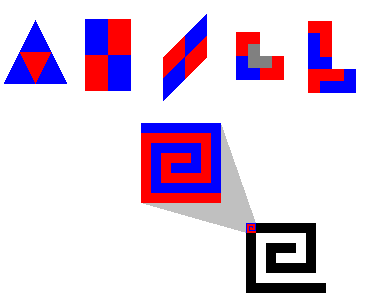
| Fractal topologically closed (each white point has a neighborhood of pure white surrounding it) vs. not |
|
| |
|
| |
| |
|
|
| |
|
| BP806 |
| Image of repeating wallpaper with only 3-fold rotational symmetries versus image of repeating wallpaper with some other symmetries. |
|
| |
|
| |
| |
|
|
| |
|
| BP81 |
| Dark figures can be divided from outline figures by a straight line vs. convex hulls of filled and outlined figures overlap. |
|
| |
|
|
|
|
REFERENCE
|
M. M. Bongard, Pattern Recognition, Spartan Books, 1970, p. 240. |
|
|
CROSSREFS
|
Adjacent-numbered pages:
BP76 BP77 BP78 BP79 BP80 * BP82 BP83 BP84 BP85 BP86
|
|
|
KEYWORD
|
finished, traditional, bongard
|
|
|
CONCEPT
|
convex_hull (info | search),
separable_entangled (info | search),
sides_of_line (info | search),
feature_cluster (info | search),
cluster_of_one (info | search),
cluster (info | search),
imagined_line_or_curve (info | search),
imagined_entity (info | search),
objects_overlap (info | search),
overlap (info | search)
|
|
|
AUTHOR
|
Mikhail M. Bongard
|
| |
|
|
| |
|
| BP1004 |
| The whole satisfies the same rule as its parts vs. not so. |
|
| |
|
|
|
|
COMMENTS
|
The "whole" is the entire panel including the bounding box. A "part" is some region either stylistically different or amply separated in space from everything else. Smaller parts-within-parts don't count as parts.
Rhetorical question: Where would the collection of left examples of this Bongard Problem be sorted by this Bongard Problem? (The question is whether these examples considered together satisfy the pattern that all the parts do, namely that the whole satisfies the pattern that all the parts do.)
See BP793 and BP999 for similar paradoxes. |
|
|
CROSSREFS
|
See BP1006 for the version about numerical properties where each part is a cluster of dots; examples in that BP would be sorted the same way here that they are there.
See BP999 and BP1003 for versions where each object is itself a collection of objects, so that the focus is on rules specifically pertaining to collections (e.g. "all the objects are different").
See BP1002 for a Bongard Problem about only visual self-similarity instead of conceptual self-similarity.
The rule shown in each panel is "narrow" (see BP513left and BP514left).
Adjacent-numbered pages:
BP999 BP1000 BP1001 BP1002 BP1003 * BP1005 BP1006 BP1007 BP1008 BP1009
|
|
|
KEYWORD
|
nice, abstract, anticomputer, creativeexamples, left-narrow, rules, miniworlds
|
|
|
CONCEPT
|
recursion (info | search),
self-reference (info | search)
|
|
|
AUTHOR
|
Aaron David Fairbanks
|
| |
|
|
| |
|
| BP210 |
| Part of at least one object is out of box vs. all objects are within the box. |
|
| |
|
| |
| |
|
|
| |
|
| BP344 |
| Shape can tile itself vs. shape cannot tile itself. |
|
| |
|
|
|
|
COMMENTS
|
Left examples are sometimes called "rep-tiles."
The tiles all must be the same size. More specifically, all left examples can tile themselves only using scaled down and rotated versions of themselves with all tiles the same size. Right examples cannot tile themselves using scaled down rotated versions of themselves or even reflected versions of themselves with all tiles the same size.
Without the puzzle piece-like shape EX4120 on the right side the current examples also allow the solution "shape can tile with itself so as to create a parallelogram vs. shape cannot tile with itself so as to create a parallelogram." |
|
|
CROSSREFS
|
See BP532 for a version with fractals.
Adjacent-numbered pages:
BP339 BP340 BP341 BP342 BP343 * BP345 BP346 BP347 BP348 BP349
|
|
|
EXAMPLE
|
Go to https://oebp.org/files/yet.png for an illustration of how some left-sorted shapes tile themselves. |
|
|
KEYWORD
|
hard, precise, notso, unstable, math, hardsort, creativeexamples, proofsrequired, perfect, traditional
|
|
|
CONCEPT
|
recursion (info | search),
self-reference (info | search),
tiling (info | search),
imagined_shape (info | search),
imagined_entity (info | search)
|
|
|
WORLD
|
shape [smaller | same | bigger]
|
|
|
AUTHOR
|
Aaron David Fairbanks
|
| |
|
|
| |
|
| BP120 |
| All turns are in one direction and rectangular loop exists vs. turns in different directions and no rectangular loop exists. |
|
| |
|
| |
| |
| |
|
|
|
|
|
|
|
|