Search: https://www.galaxus.ch/en/sector/showdiscussion/snapchathacking-visit-kunghaccom-5hflaboo-226168
|
|
|
|
|
Sort:
relevance
Format:
long
Filter:
(all | no meta | meta)
Mode:
(words | no words)
|
|
|
|
|
|
| |
|
| BP1237 |
| Connected fractal vs. disconnected fractal. |
|
| |
|
| |
| |
|
|
| |
|
| BP172 |
| Rotationally symmetric vs. not. |
|
| |
|
| |
| |
|
|
| |
|
| BP65 |
| A set of triangles elongated horizontally vs. a set of triangles elongated vertically. |
|
| |
|
|
|
|
REFERENCE
|
M. M. Bongard, Pattern Recognition, Spartan Books, 1970, p. 235. |
|
|
CROSSREFS
|
Adjacent-numbered pages:
BP60 BP61 BP62 BP63 BP64 * BP66 BP67 BP68 BP69 BP70
|
|
|
KEYWORD
|
noisy, spectrum, rotate, finished, traditional, viceversa, bongard
|
|
|
CONCEPT
|
convex_hull (info | search),
elongated_compact (info | search),
horizontal (info | search),
cluster (info | search),
similar_feature (info | search),
similar (info | search),
vertical (info | search)
|
|
|
WORLD
|
[smaller | same | bigger]
|
|
|
AUTHOR
|
Mikhail M. Bongard
|
| |
|
|
| |
|
| BP1003 |
| The combined collection obeys the same rule as the sub-collections vs. not so. |
|
| |
|
|
|
|
COMMENTS
|
Since it is most intuitive to imagine spatially squishing together all the collections in the process of combining them into one big collection, avoid rules that involve relative spatial positionings of objects. |
|
|
CROSSREFS
|
Contrast BP999, which is very similar. There, when considering the whole picture, the collections are to be treated as individual objects; here, when considering the whole picture, the collections are to be combined into one big collection. A picture showing (for example) an odd number of even-numbered groups would be sorted differently by these two BPs.
Also contrast BP1004, which is about a collection of plain objects obeying the same rule as all the objects (instead of a collection of [collections of objects] obeying the same rule as all the [collections of objects]).
See BP1006 for the version with only number-based properties. All panels in that Bongard Problem fit the same way in this Bongard Problem as well.
Adjacent-numbered pages:
BP998 BP999 BP1000 BP1001 BP1002 * BP1004 BP1005 BP1006 BP1007 BP1008
|
|
|
KEYWORD
|
nice, abstract, notso, creativeexamples, rules, miniworlds
|
|
|
CONCEPT
|
recursion (info | search),
self-reference (info | search)
|
|
|
WORLD
|
[smaller | same | bigger]
|
|
|
AUTHOR
|
Leo Crabbe, Aaron David Fairbanks
|
| |
|
|
| |
|
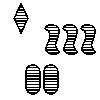
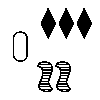
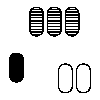
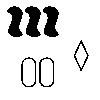
| BP1138 |
| Each attribute is shared by every group or none vs. some attribute is shared by exactly two groups |
|
| |
|
|
|
|
COMMENTS
|
Attributes are shading, shape, and number.
There are always three groups.
This problem is related to the card game Set. |
|
|
CROSSREFS
|
Adjacent-numbered pages:
BP1133 BP1134 BP1135 BP1136 BP1137 * BP1139 BP1140 BP1141 BP1142 BP1143
|
|
|
KEYWORD
|
nice, precise, allsorted, notso, preciseworld
|
|
|
CONCEPT
|
all (info | search),
number (info | search),
same (info | search),
two (info | search),
three (info | search)
|
|
|
AUTHOR
|
William B Holland
|
| |
|
|
| |
|
| BP146 |
| A shape contains a square if and only if it is a circle vs. a shape contains a square if and only if it is a triangle. |
|
| |
|
| |
| |
|
|
| |
|
| BP904 |
| Rows show all possible ways a certain number of dots can be divided between a certain number of bins vs. not so. |
|
| |
|
| |
| |
|
|
| |
|
| BP13 |
| Tall rectangle OR wide ellipse vs. wide rectangle OR tall ellipse. |
|
| |
|
|
|
|
COMMENTS
|
All examples in this Bongard Problem are outlines of ellipses or rectangles aligned to the x-y-axes. |
|
|
REFERENCE
|
M. M. Bongard, Pattern Recognition, Spartan Books, 1970, p. 218. |
|
|
CROSSREFS
|
Adjacent-numbered pages:
BP8 BP9 BP10 BP11 BP12 * BP14 BP15 BP16 BP17 BP18
|
|
|
KEYWORD
|
precise, stretch, finished, traditional, preciseworld, bongard
|
|
|
CONCEPT
|
or (info | search),
horizontal (info | search),
line_slope (info | search),
vertical (info | search)
|
|
|
WORLD
|
rectangle_or_ellipse_outline_axis_aligned [smaller | same | bigger]
|
|
|
AUTHOR
|
Mikhail M. Bongard
|
| |
| |
|
|
|
|
|
|
|
|